My role and contributions
This case study preserves the design, delivery and retrospective from my participation; future recommendations are lessons from the completed engagement.
As AI product manager, I led platform evaluation, capability-layer design, governance standards and training.
7+
Platforms evaluated
~30
Users trained
5
Capability elements
3
Stack components
Challenge
Platform selection, capability governance, tool integration and enablement all had to work at once. A single vendor tool could not close the loop.
Solution
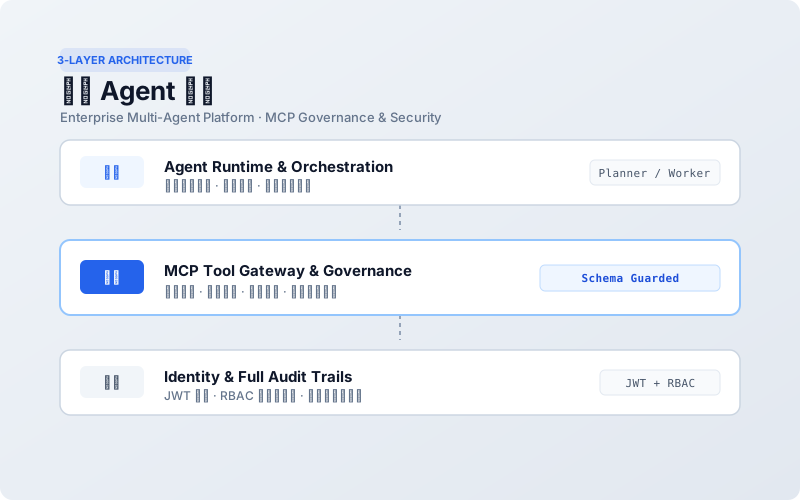
I compared 7+ platforms (Aily, Dify OSS, WorkBuddy, …) and defined a capability layer around people, agents, skills, tools and data — connected by governance, reuse and business composition.
People
Who can call what, and where the permission boundary sits.
Agents
Each agent's capability range and callable tools are explicitly constrained.
Skills
Skills carry a lifecycle and version, and can be reused and composed.
Tools
Integrated once through MCP rather than wired separately per agent.
Data
Identity propagation keeps the data-access path auditable.
Key decision
Why Aily + Dify OSS + WorkBuddy instead of locking into one vendor? The loop spans different layers of capability, and a combined stack balances capability, cost, and control.
System path
Users reach business systems through an agent, AI Gateway and MCP capability layer, with identity and permissions passed along the call path.
Technical details
Governance
- RBAC for roles and permissions.
- Tool scope limiting what each agent can call.
- Identity propagation from user through agent to business system.
- Agent governance: high-risk action confirmation and audit.
Platform
- Aily + Dify OSS + WorkBuddy instead of locking into one vendor.
- Skill lifecycle and permission ranges.
Results
The combined stack and capability-layer definitions were delivered, alongside training for ~30 users. Sustained adoption still needs to be assessed through actual use.
Why it matters
New use cases can reuse existing agents, skills and tools.
Lessons learned
Next time, judge success by sustained adoption in high-frequency use cases — not training reach.